Design and Synthesize a Biomodule

Create, annotate, mutate and share your DNA building blocks

Delivered as linear dsDNA or subcloned


What is a Biomodule?

A Biomodule is a linear double-stranded DNA fragment with a well defined biological function such as CDS, terminator or gRNA.
Biomodule are the building blocks of TriLink's platform and allow you to design large and complex synthetic biological constructs by simply assembling small and well-characterized DNA parts. The main advantage behind Biomodule is the modularity concept, any Biomodule can be reused in different constructs to streamline and speed-up the design process.
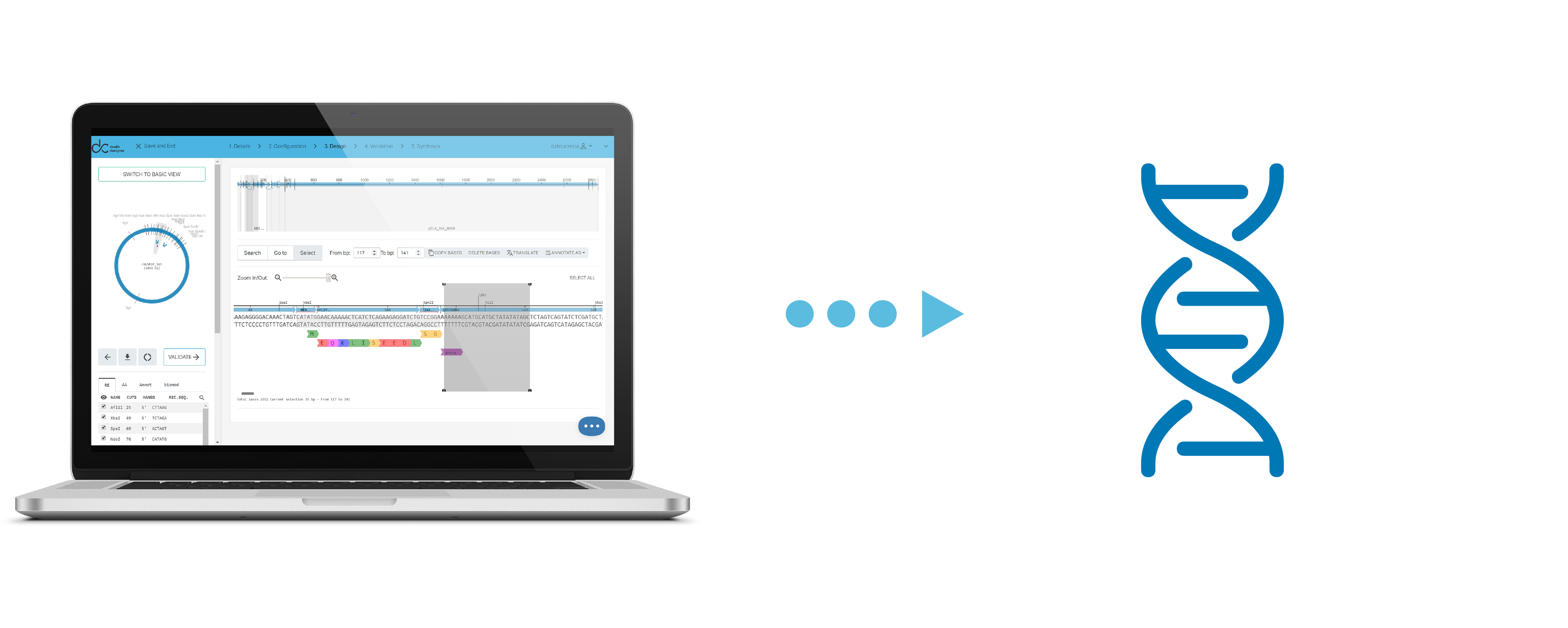
Single sequence
What is the difference between a Biomodule and a BioBrick?

If you are wondering what the difference between biomodules and BioBricks® is, well, the very modular concept behind biomodules and BioBricks® is the same. However, TriLink's biomodules are usually longer than 25bp so that you can actually handle them in the wet lab. At the same time, a biomodule is usually shorter than 25kbp since extremely long dsDNA fragments are highly unstable in downstream applications, such as genome assembly and mutagenesis.

Tips & Tricks
Biomodules usually do not contain any restriction sites required for cloning. Restriction sites are rather usually carried by the Backbone to allow easy swapping between different plasmids.

Accepted inputs: A, C, G, T, W (weak: A, T), S (strong: C, G ), M (amino: A, C), K (keto: G, T), R (purine: A, G ), Y (pyrimidine: C, T), B (not A), D (not C), H (not G), V (not T), N (any basebase)
Blast BP: 0
Sequence and name fields will be overridden
Biosafety level*
By selecting the biosafety level corresponding to the project, customer confirms that (i) such classification is correct and accurate and (ii) that the customer has read, understood and accepted the biosafety confirmation.

Create your free account

  • Your password can’t be too similar to your other personal information.
  • Your password must contain at least 8 characters.
  • Your password can’t be a commonly used password.
  • Your password can’t be entirely numeric.